
Walk through the parking lot at any rally and the vests do the talking before anyone says a word. A top rocker, a center patch, a small tab on the chest: to riders who know the language, a vest says who you ride with, where you ride and what you have earned. Most of that language is open to everyone. A few pieces of it are not.
This guide explains what the most common biker patches usually mean, the etiquette most riders expect, and the patches to avoid if you are not a member of a club. One thing up front: there is no single rulebook. Customs vary from one club, state and country to the next, and what follows describes widely reported conventions, not laws. When in doubt, ask riders in your area. Local custom always comes first.
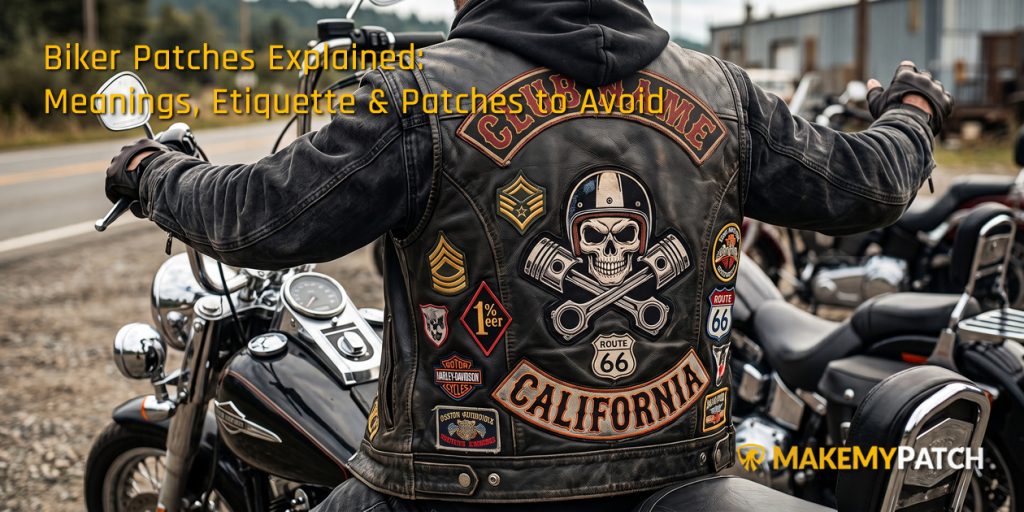
Why patches matter so much in biker culture
In the motorcycle club world, a club’s insignia is called its colors, and it is worn on the back of a leather or denim vest (often called a cut or kutte). In many clubs those colors are not bought, they are earned. Members often pass through stages such as “hang-around” and “prospect” before a membership vote, and only then receive the full patch. That is where the expressions “full-patch member” and “getting patched” come from. The exact process varies widely from club to club.
That is why a patch can mean far more to the person wearing it than a piece of embroidery. Wearing something that looks like it was earned, when it was not, is the fastest way to start a bad conversation.
The anatomy of a club vest: 1-, 2- and 3-piece patches
Most club back patches are built from up to three elements:
- Top rocker: the curved banner across the shoulders, usually with the club or group name.
- Center patch: the logo or emblem.
- Bottom rocker: the curved banner under the logo, usually showing a location: a state, region, city or chapter.
Small rectangular tabs such as “MC” or “RC” often sit beside the center patch. If you want the full breakdown of sizes and layouts, read our guide to custom back patches for motorcycle clubs.
The number of pieces is often read as a signal. Here is how the convention is usually described:
| Layout | What it usually signals | Typical wearers |
|---|---|---|
| 1-piece back patch | A personal design or a group that does not claim territory | Independent riders, riding clubs, social and charity groups |
| 2-piece (top rocker + center, or center + bottom rocker) | An organized group, sometimes a club in an early stage | Riding clubs, some new clubs |
| 3-piece (top rocker + center + bottom rocker) | A full motorcycle club member, with the bottom rocker naming the club’s territory | Traditional MCs |
A 3-piece set does not automatically mean an outlaw club: many law-abiding motorcycle clubs wear one. But because the bottom rocker is widely read as a claim to territory, the 3-piece layout is the one that carries the most weight.
Common biker patches and what they usually mean
MC vs. RC tabs
An “MC” tab identifies a motorcycle club. “RC” stands for riding club, a group built around riding together, usually without the membership structure and territorial customs of a traditional MC. Many riding clubs wear a 1-piece or 2-piece layout for exactly that reason.
Prospect and probate patches
These identify someone who is going through the membership process. In some clubs, a prospect wears only part of the colors, such as the bottom rocker or the club name, until they are voted in.
Officer and rank tabs
Tabs such as President, Vice President, Sergeant at Arms, Road Captain, Secretary or Treasurer show a role inside a club. They are given by the club, not chosen by the rider.
The 1% diamond
The diamond-shaped “1%” patch is the most loaded patch in biker culture. It is usually traced to a remark attributed to the American Motorcyclist Association after the 1947 Hollister riot, that 99% of motorcyclists were law-abiding, implying the last 1% were not. The AMA has said it has no record of ever making that statement. Either way, the diamond became a badge worn by outlaw clubs, and it is not a novelty patch.
Memorial patches
“In Memory Of” and “RIP” patches, often with a name and dates, honor fallen riders, friends and family. They are personal, widely worn and widely respected.
Numbers and symbols
Some numbers, letters and symbols carry specific meanings inside specific clubs, and those meanings are not always public. If you do not know exactly what a number or symbol patch means and who wears it, do not put it on your vest.
Biker patches to avoid if you are not a member
None of these are official rules, but they are the patches most often mentioned by riders as the ones that cause trouble:
- Another club’s colors, logo or name. This is the big one. Wearing a club’s colors without being a member is seen as deeply disrespectful, and many clubs have registered their names and logos as trademarks, so copying them can create legal problems too.
- The 1% diamond. It is tied to outlaw clubs, not to riding in general.
- A full 3-piece layout as an independent rider. Top rocker, center and bottom rocker together read as a club claiming territory. A single back patch says “I ride” without saying anything else.
- A state bottom rocker under a club-style patch. In parts of the motorcycle club world, a state name in that position is read as a claim to the whole state. Many independent riders and riding groups choose a city, county or region instead, or no bottom rocker at all.
- Officer, rank or prospect tabs you were not given. They describe a role inside a club. Wearing them “for fun” can be taken seriously.
- Number or symbol patches you do not fully understand. Look it up, ask, or skip it.
- “Lookalike” designs. A logo that is a slightly changed version of a real club’s colors is still read as those colors.
Etiquette beyond the patch
- Riding clubs and new clubs: before choosing a name, a color combination and a layout, look at which clubs are already established in your area. Many new groups talk with local clubs first to avoid misunderstandings.
- “No colors” venues: some bars, casinos and events post “no colors” policies that ban club vests and insignia inside. Respect the sign, or keep a plain jacket handy.
- Respect the vest: for many members, their colors represent years of commitment. Treat someone else’s vest the way you would want yours treated.
What you can wear freely
The good news: almost everything else is yours to wear. Riders put together vests full of personality without stepping on anyone’s toes:
- A 1-piece back patch of your own original design: a skull, an eagle, a flag, your bike, your motto.
- Name tags and road names.
- Rally, run and charity ride patches.
- Memorial patches for someone you lost.
- Flags, military and veteran pride patches with generic text, faith patches and humor patches.
- For an organized riding group: your own original group name, logo and layout, agreed by the group.
Looking for a starting point? See our custom embroidered patches for MC vests or the custom patch set for biker vests, both made from your own design.
Designing original colors with MakeMyPatch
Whether you ride solo, run a riding club or are starting a new club, the safest patch is an original one. Here is how we work:
- Free quote: send your idea, sketch or logo and we come back with a quote.
- Digital mockup first: you see your design before production.
- No minimum quantity on embroidered patches, so a solo rider does not have to order in bulk.
- We respect club colors: we never reproduce an existing club’s colors or a 1% patch unless the order comes from, or is approved by, that club’s president.
FAQ: biker patches explained
Yes. Most patches (personal back patches, name tags, rally, memorial, flag and humor patches) are worn by riders who are not in any club. What riders generally avoid is anything that imitates a club: another club’s colors, a 3-piece layout, the 1% diamond, or officer tabs.
A 3-piece patch is a top rocker, a center logo and a bottom rocker. It is traditionally worn by full members of a motorcycle club, and the bottom rocker usually names the club’s territory or chapter.
It depends on local custom. Many riding clubs wear a 1-piece or 2-piece layout, and those that use a bottom rocker often choose a city or region rather than a state name. Ask riders and clubs in your area before ordering.
The 1% diamond is linked to outlaw motorcycle clubs. It refers to a famous but disputed claim that 99% of motorcyclists are law-abiding. It is not a patch to wear as a fashion statement.
Not unless the order comes from, or is approved by, that club’s president. We are happy to help you build original colors instead.
Ready to design patches you can wear with pride?
Your vest should tell your story, not borrow someone else’s. Send us your idea and get a free quote with a digital mockup: get your free quote.