
You’ve got a logo, a team name or a club design, and you’re ready to turn it into a patch. Then comes the first real decision: embroidered or woven? At a glance the two look similar, but they’re made differently, they show detail differently, and each one shines in different situations. This guide breaks down the differences so you can pick the right patch the first time.
What Are Embroidered Patches?
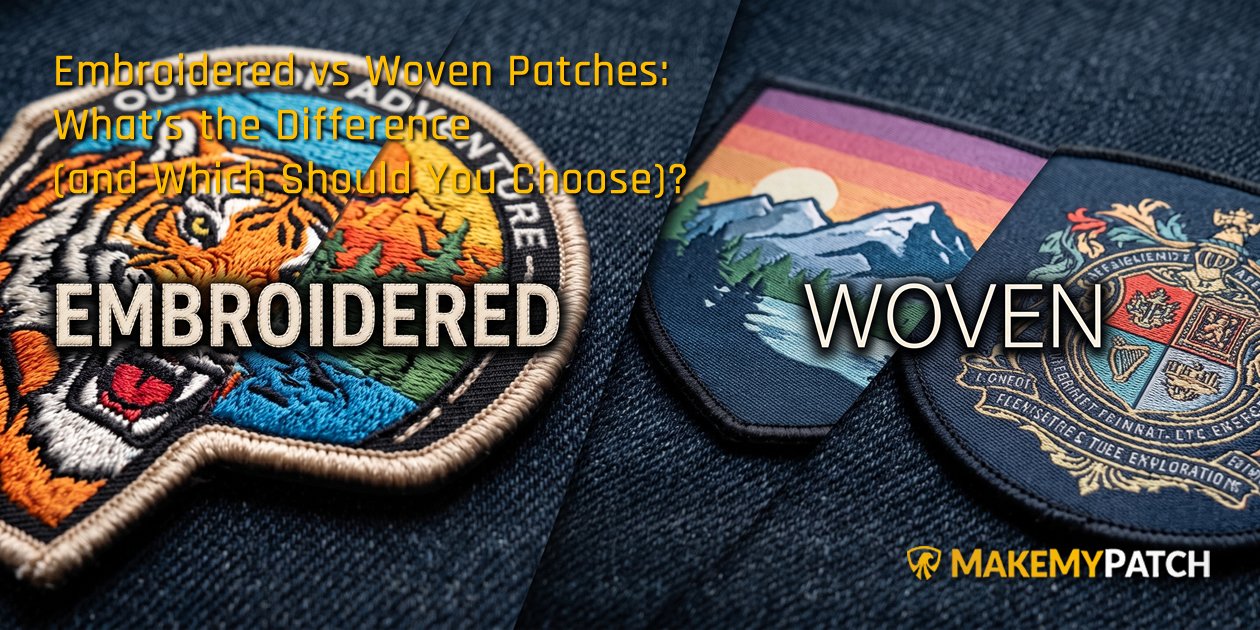
Embroidered patches are the classic patch most people picture. Your design is stitched onto a twill backing with thick threads, which gives the patch a raised, textured, three-dimensional look. You can feel the design when you run your fingers over it.
Because the threads are relatively thick, embroidery works best with bold shapes, solid colors and medium-to-large lettering. It’s the go-to choice for motorcycle club back patches, uniforms, sports teams, scouts and any design that should look rugged and traditional.
- Look: raised, textured, classic
- Best for: bold logos, simple shapes, large text
- Feel: thicker and more substantial
What Are Woven Patches?
Woven patches are made on a loom, with much thinner threads woven tightly together, similar to the labels inside your clothing. The result is a flat, smooth patch with a fine finish.
Thinner threads mean woven patches can reproduce small text, thin lines and intricate details that embroidery can’t capture cleanly. They’re also thinner and lighter, which makes them comfortable on hats, lightweight fabrics and fashion pieces.
- Look: flat, smooth, high-detail
- Best for: fine text, detailed artwork, small sizes
- Feel: thin, light and flexible
How Each Type Is Made
Understanding the production process explains most of the differences between the two.
The embroidery process
Your artwork is first converted into a stitch file, a map that tells the embroidery machine where every stitch goes, in what direction and in which color. The machine then stitches the design onto a sturdy twill fabric, layer by layer. Fill areas use dense rows of stitches, while outlines and lettering use satin stitches that catch the light. Once the stitching is done, the patch is cut to shape and finished with a border, usually a thick merrowed edge for round or rectangular patches, or a heat-cut edge for custom shapes.
Because each stitch has a minimum length and the threads are fairly thick, there’s a practical limit to how small a detail can be. That’s why very fine lines or tiny letters tend to fill in or lose their shape on an embroidered patch.
The weaving process
Woven patches are produced on a jacquard loom. Instead of stitching on top of a fabric, the design is woven directly into the fabric itself, with very thin threads crossing over and under each other. The higher thread count allows the loom to “draw” much finer details, which is why woven labels can show small text that stays readable.
The trade-off is texture: the design sits in the same flat plane as the background, so a woven patch doesn’t have the raised feel of embroidery.
Embroidered vs Woven: Side-by-Side Comparison
| Embroidered Patches | Woven Patches | |
|---|---|---|
| Detail level | Good for bold designs | Excellent for fine detail and small text |
| Texture | Raised, 3D feel | Flat and smooth |
| Thickness | Thicker | Thinner and lighter |
| Look | Traditional, rugged | Clean, modern, refined |
| Small sizes | Details can get lost | Stays crisp |
| Ideal uses | Biker vests, uniforms, team jackets, scouts | Hats, fashion, labels, detailed logos |
When to Choose Embroidered Patches
Go with embroidery when you want your patch to stand out with texture and presence:
- Motorcycle clubs and biker vests: large back patches and rockers have that bold, stitched look riders expect.
- Uniforms and workwear: name tags, company logos and rank patches look professional and hold up to daily wear.
- Sports teams: team crests and numbers pop on jerseys and jackets.
- Clubs, scouts and organizations: embroidery gives a sense of tradition and pride.
Rule of thumb: if your design reads clearly from a few feet away and doesn’t rely on tiny text, embroidery is a great fit.
When to Choose Woven Patches
Choose woven when detail matters more than texture:
- Detailed logos: thin lines, small shapes and fine outlines stay sharp.
- Small text: slogans, dates or long names that would blur in embroidery.
- Hats and lightweight fabrics: a thin patch sits flat and comfortable.
- Fashion and brand labels: a clean, refined look for apparel brands.
Rule of thumb: if your artwork has lots of small elements or your patch is under about 2 inches, woven will usually reproduce it better.
Can You Combine Both?
Yes. Many brands and clubs order both types: an embroidered patch for the main logo on a jacket back, and woven patches for smaller items like hats or sleeve details. Using the same artwork in both styles keeps your look consistent across everything you wear or sell.
Choosing the Right Backing
Whichever type you choose, the backing determines how the patch attaches to your item:
- Sew-on: the most secure and durable option, recommended for jackets, vests and anything washed often.
- Iron-on: a heat-activated adhesive for quick application on cotton and denim. For extra hold, you can add a few stitches afterward.
- Hook-and-loop (Velcro): lets you swap patches easily, popular for tactical gear, uniforms and backpacks.
Thicker embroidered patches pair especially well with sew-on backing on heavy fabrics, while thin woven patches are easy to iron onto lighter garments.
Still Not Sure? Ask Yourself These 3 Questions
- How detailed is my design? Lots of fine detail or small text → woven. Bold and simple → embroidered.
- How big will the patch be? Small patches favor woven; medium and large patches look great embroidered.
- What look do I want? Raised and classic → embroidered. Flat and refined → woven.
How MakeMyPatch Can Help
At MakeMyPatch, we make custom patches every day for clubs, teams, businesses and individuals. Send us your design and we’ll recommend the patch type that will reproduce it best. Quotes are free, so you can compare options before you commit.
Frequently Asked Questions
Both are durable when properly attached. Embroidered patches are thicker and very hard-wearing; woven patches are tightly made and resist fraying well. For items washed often, sewing the patch on gives the best long-term hold for either type.
It depends on size, colors and quantity, so the best way to compare is to request a free quote for both versions of your design.
Yes, both embroidered and woven patches can be made with an iron-on backing, a sew-on finish, or other backing options.
Not really. Woven patches are flat by nature. If texture and dimension are important to you, embroidery is the better choice.
Both can work. Woven patches are thin and light, so they sit flat on curved caps and keep small details crisp. Embroidered patches give a bolder, more classic look on the front of a cap if your design is simple.